
WASTE STORAGE TANKS (TANK FARMS I,II,III)
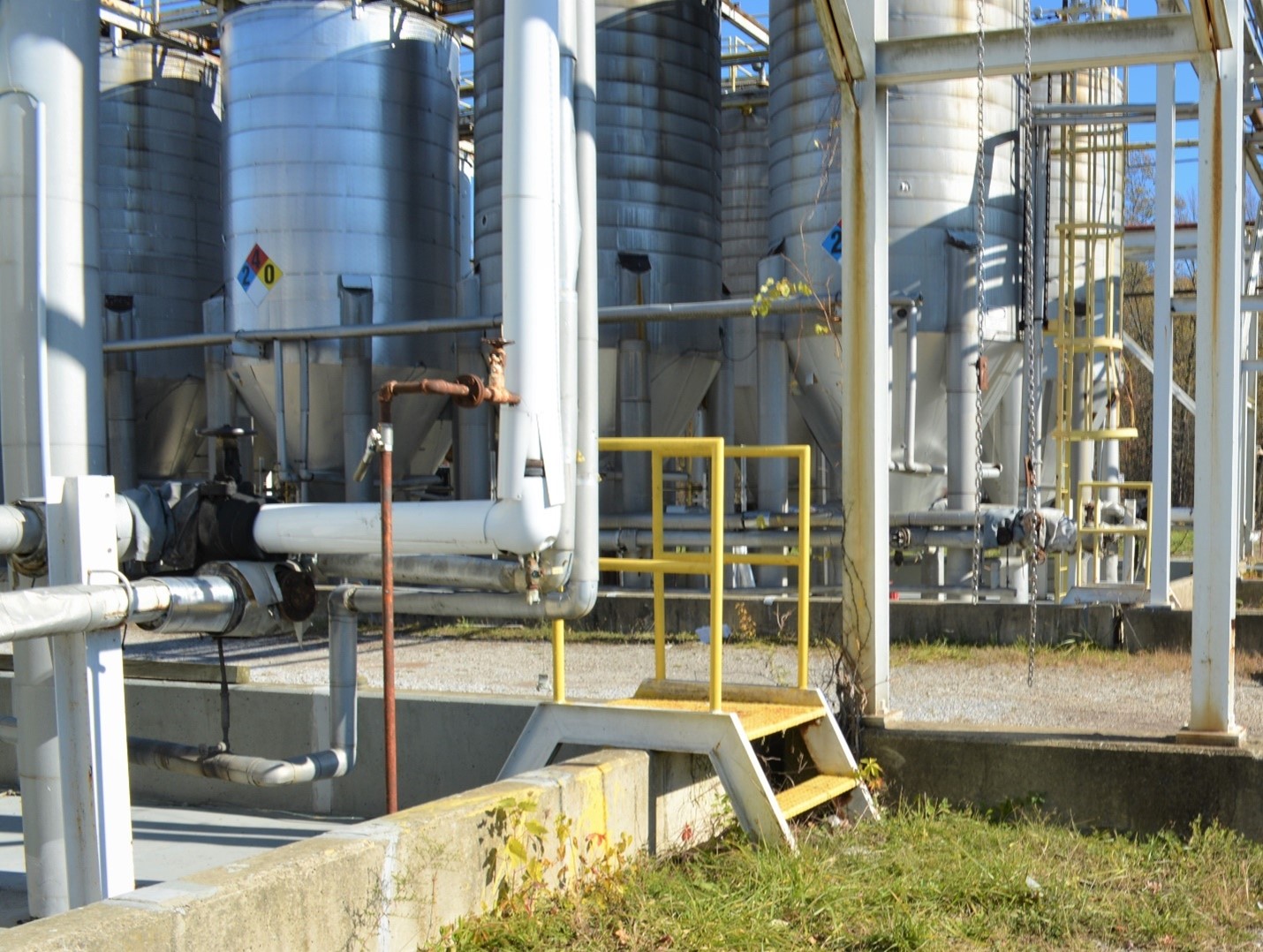
RIS utilizes three Tank Farms (42 tanks) for the storage of liquid wastes received at the RIS facility. Liquid wastes are typically vacuumed or pumped from tanker trucks or containers at the Process Dock as described above. RIS may also pump liquids directly from a tanker truck into the storage tanks (23 through 64) from unloading stations located between the tank secondary containment walls.
RIS determines which tanks the material is transferred to depending on the availability of tank storage space and the compatibility of the material with the waste already being stored in the tank. If the characteristics of the waste material are within the specified limits and ranges, then the waste material is transferred to the tank farm storage tanks.
In addition, compatibility tests are performed on all dock bulking operations. The vapors purged from the Tank Farm tanks are processed in the vapor recovery system prior to being released to the atmosphere. The tank system includes insulated, heated piping to protect against freezing, nitrogen blanketing to minimize fire hazards, and a vapor control system to minimize odor and emissions.
RIS Tank Farm tank replacement began in 2021 (6 tanks) and 2023 (7 tanks).
WASTE TREATMENT TANKS
RIS utilizes treatment tanks (Tanks 70, 73 and 74) to treat liquid wastes. Tanks 73 and 73 are agitated vacuum tanks used to collect liquids from containers and tank trucks. The liquids collected in Tanks 70, 73 and 74 are then transferred to the storage tanks (Tanks 23 to 64) or to an awaiting tanker.
SCRUBBER WATER STORAGE TANKS
RIS utilizes three tanks (67, 68 and 75) for processing residuals (scrubber water and fly ash sludge) from the air pollution control equipment. Tanks 67 and 68 are the feed tanks for the filter press. Residual liquids from the filter press unit are recycled back to the clarifier, maintenance storage tank, or disposed of offsite. RIS ships scrubber water blowdown off-site as needed to minimize the concentration of salts and other contaminants in the closed loop scrubber water system. Tank 75 (Maintenance Storage Tank) is a storage tank that is typically used whenever the clarifier is out of service for repairs and maintenance or to store scrubber water prior to shipment off-site. Tank 75 stores scrubber water from the Closed Loop Scrubber Water System or fresh water from any on-site fresh water supply.
Underground storage tanks
There have never been any Underground Storage Tanks (USTs) on site.
SECONDARY CONTAINMENT FOR ABOVE GROUND STORAGE TANKS
All of the tanks have secondary containment systems constructed of a reinforced concrete liner and a reinforced concrete retaining wall around the perimeter, all with an impermeable coating. The secondary containment systems are external to the tank(s), are sloped, and contain sumps, which combined with daily inspections, provide a system of removing liquids resulting from leaks, spills, or precipitation within 24 hours of discovery.
SAFETY CUT-OFFS, BYPASS SYSTEMS, & PRESSURE CONTROLS FOR TANK SYSTEMS
Tanks 23-64 are equipped with liquid level indicators for monitoring the level of liquid in each tank. Each tank is equipped with an alarm to indicate when the tank is filled. Tanks 73 and 74 are equipped with high level alarms and pressure/vacuum relief vents. Tank 70 is equipped with a rupture disc, which ruptures and must be replaced if the pressure in the tank exceeds the disc’s design pressure.
Each tank is equipped with a nitrogen blanketing system, which minimizes the oxygen level in each tank and minimizes the possibility of fires in the tank. Each tank is equipped with a pressure relief vent in case a sudden pressure increase is experienced in the tanks.
Tanks 67, 68 and 75 are equipped with liquid level indicators and Tank 75 (Maintenance Storage Tank) is equipped with a high-level alarm to alert the operator when the tank is full. Tanks 67, 68 and 75 do not contain organics and are vented to the atmosphere to prevent over pressurization.
EXTERNAL CORROSION PROTECTION
All of the tanks and ancillary equipment are above ground and no metal components of the tank systems are in contact with the soil or water. The exteriors of all tanks are painted, thus providing protection from the environment. RIS has instituted a two part program to ensure the integrity of all tanks. The first part of this program entails the pre-screening of wastes by corrosion rate. The corrosion rate is determined by the generator when completing the WPS form that accompanies a waste on-site. Wastes with a corrosion rate greater than 50 mils penetration per year (MPY) are not stored in tanks. Instead, these wastes are direct fed to the incinerator system. Wastes with a corrosion rate between 30 and 50 MPY are stored no longer than 30 days in tanks. The second part of this program includes an in-situ monitoring program which uses corrosion coupons in the tanks.
REQUIREMENTS FOR SECONDARY CONTAINMENT AND LEAK DETECTION
All of the tanks have been provided with a secondary containment system constructed of a reinforced concrete liner and a reinforced concrete retaining wall around the perimeter, all with an impermeable coating. The secondary containment systems are external to the tank(s), are sloped, and contain sumps, which combined with daily inspections, provide a system of removing liquids resulting from leaks, spills, or precipitation within 24 hours of discovery.
TANK PIPING
All above ground piping is inspected daily to detect leaks, cracks, excessive pressure, corrosion, or deterioration. The above ground piping is only subject to atmospheric pressure. However, most of the above ground piping has common secondary containment with that of the tanks. Exceptions for above ground piping include:
- Piping between the processing dock containment (Tanks 70, 73 and 74) and the storage tank containment (Tanks 23 through 64)
- Piping between the closed loop scrubber water system containment and the incinerator containment.
Additionally, the pipes, valves, etc. that run from the storage tanks (Tanks 23 through 64) to the metering pump building at the incinerator have secondary containment provided by a pipe trench.