
ONSITE FINGERPRINT LABORATORY
RIS conducts fingerprint analysis on 100% of the loads intended for receipt at the facility. Upon receipt of a waste shipment at the Facility, the manifest and accompanying paperwork are reviewed for accuracy and conformity. Also, RIS conducts a drum count (van loads)/waste quantity (bulk loads) verification to assure that the quantity of waste shipped to the facility conforms to the manifest.
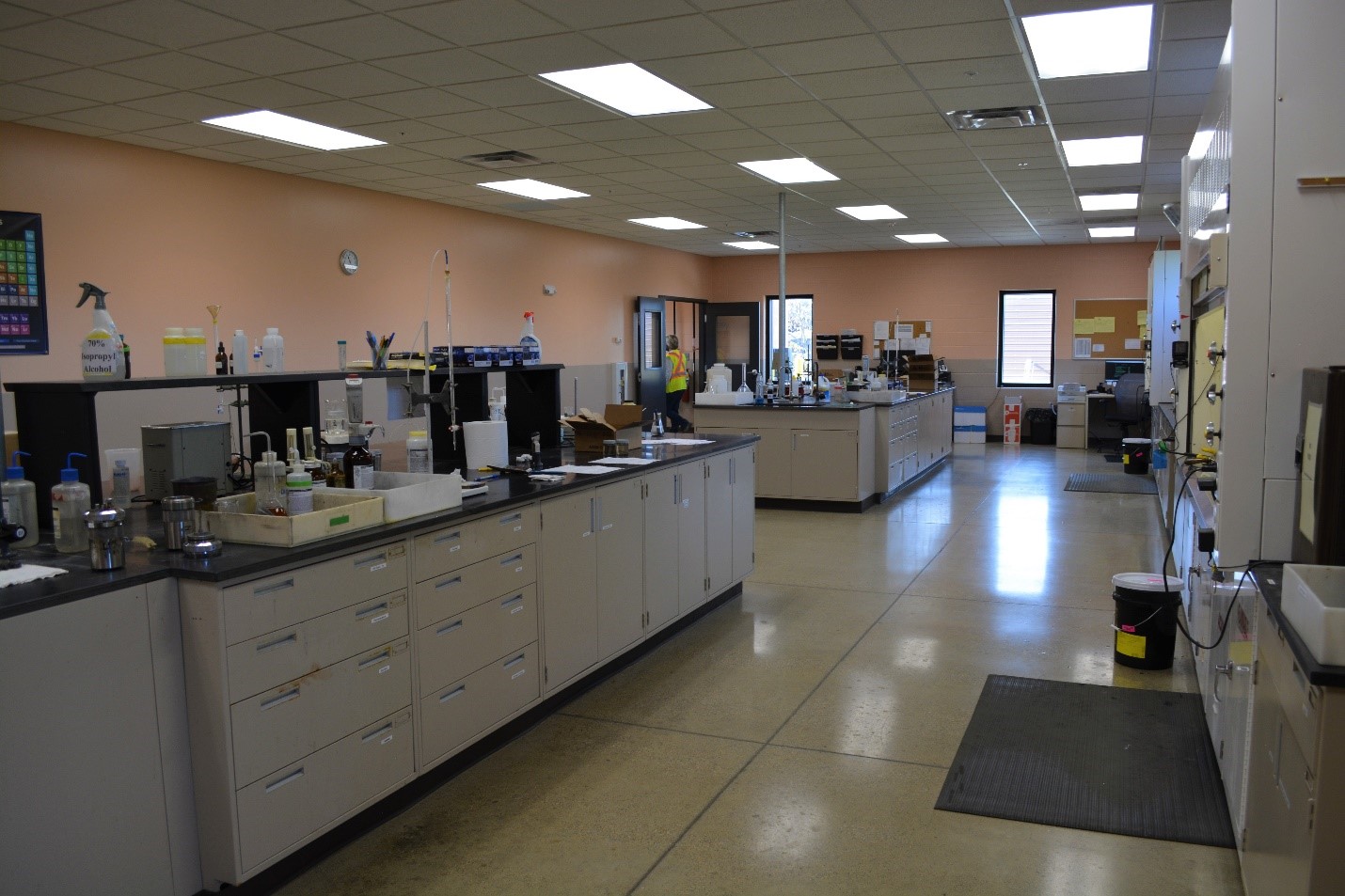
RIS conducts fingerprint analyses on each incoming waste stream to determine conformity to the WPS (profile). Samples from the same WPS may be composited for fingerprint sampling. RIS’ fingerprint analysis consists of tests for flash point (liquids only), pH (aqueous liquid only), specific gravity, total organic halogen (TOH) and/or Total Halogen, cyanide/sulfide presence, and BTU value. RIS also conducts testing for the certain metals (Pb, Hg, As, Be, Cd, Cr), and PCBs in accordance with RIS’ (Waste Analysis Plan) testing program. For trans-shipped wastes, RIS conducts the same fingerprint analyses as for wastes treated onsite; however, RIS is not required to test these wastes for viscosity or metals.
RIS conducts a 100% visual inspection of each profiled waste the first time it is shipped to the facility. The physical appearance of the waste is compared to the “physical description” provided by the generator on the WPS. Any waste that does not match the WPS upon inspection will be considered discrepant.
RIS conducts fingerprint analysis on 10% of the containers of each waste stream and metals (Arsenic, Beryllium, Cadmium, Chromium, Lead, and Mercury) testing on the first shipment of each high volume WPS. Routine testing (every 12, 24, or 36 months), random testing and volume-based testing for the metals are also performed throughout the year. This random metals testing is a relatively complex system that is based on the amount of waste received from each generator and the type of generator (i.e., third party or direct customer).
PCB analysis is performed initially and routinely (every 12 to 24 months) on waste streams that have the potential to contain PCBs. In addition, random PCB testing is performed on the general population of wastes received at the facility throughout the year.
FINGERPRINT LABORATORY EQUIPMENT
RIS’ onsite fingerprint laboratory is capable of performing the following analyses: total organic carbon testing, flash point, pH, titration, conductivity, temperature, weight, specific gravity, density, halogen content, viscosity, ash content, moisture content, solids content, paint filter liquids test, oxidizer screen, and others. RIS’ Fingerprint Lab equipment includes:
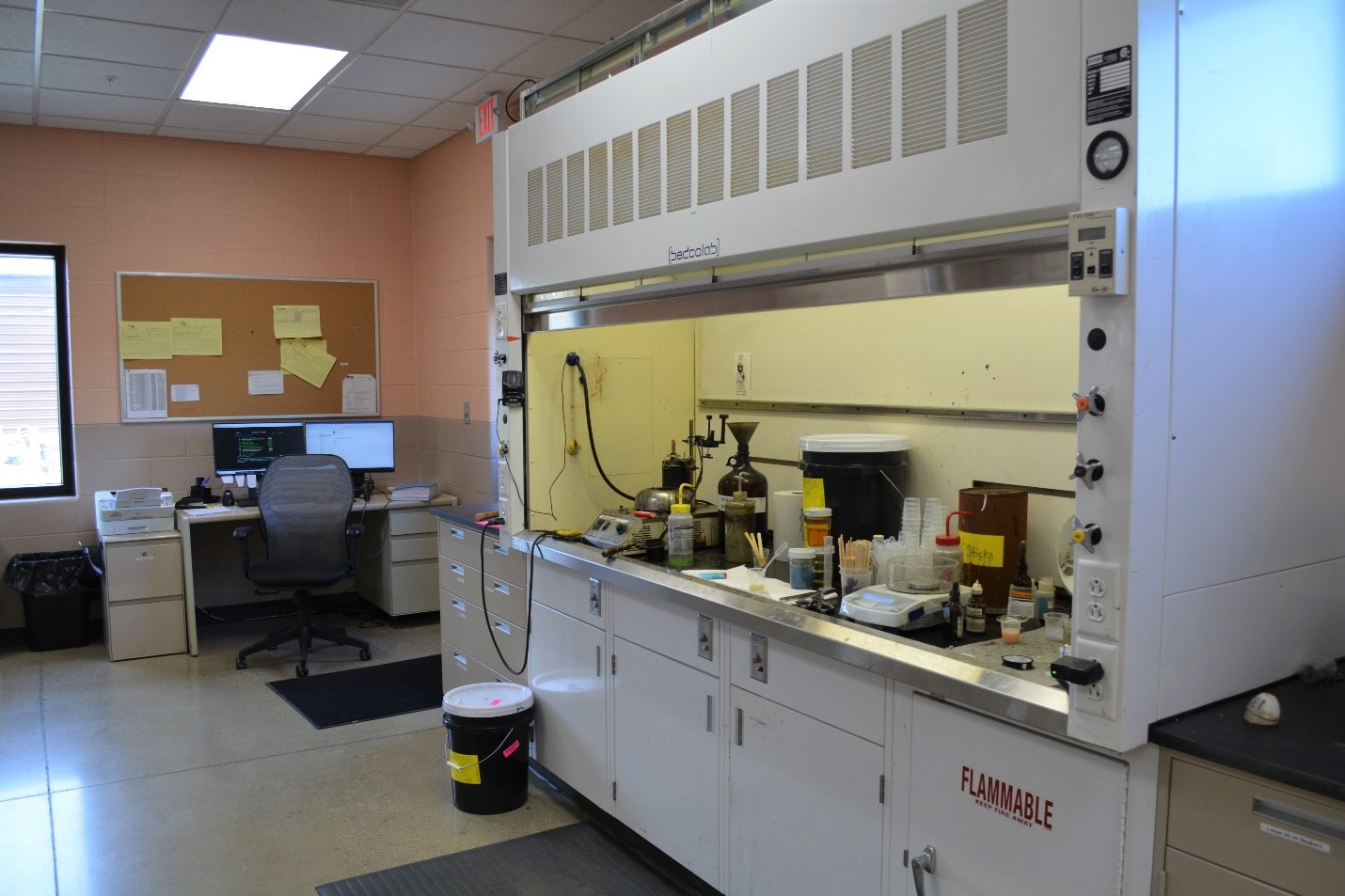
- X-ray Fluorescence (“XRF”) unit for inorganic screening,
- Total Organic Carbon tester,
- pH probes,
- Closed Cup Flash Point Tester,
- Calorimeters,
- Muffle Furnace,
- Vacuum Furnace,
- Drying Oven,
- a Rotational Viscometer,
- Selective Ion Electrodes,
- Analytical Balance,
- Fourier Transform Infrared Spectrometer (“FTIR”) for organic identification,
- Ludlum Model 19 for measuring radioactivity,
- Dual TGA/TGA (Thermogravimetric Analysis meter) for measuring burn rate characteristics,
- Various single gas meters,
- centrifuges,
- polarized light microscope,
- Laser Induced breakdown instrument. (“LIBS”) that can qualitatively measure a sample’s metal elements.
Waste samples may also be sent offsite to a contract lab for additional analyses such as PCBs and metals.
Although RIS’ fingerprint lab follows all the same standard operating procedures of a certified lab, it is not independently certified as it is a production laboratory. Although the on-site laboratory can do pre-qualification screening, it does not provide that service as 90% of the lab work is fingerprint testing with the balance being process-related analysis. Testing of residual wastes, ash, filter cake, scrubber water, are conducted at a third-party certified laboratory. Routine PCB and metals testing are conducted by an outside certified laboratory. Both written and electronic logs of analytical results are kept.
Waste Parameters for Sample Analysis
Generally, RIS does not require generators to send pre-acceptance samples. However, if RIS requires a pre-acceptance sample, analyses may include fingerprint parameters (pH, BTU value, flash point, presence of cyanide/sulfide, and total organic halogen), metals, PCBs, and paint filter liquid test. Additionally, spectrometry or thermal analysis may be conducted to further classify waste.
All wastes require profiling, including wastes being trans-shipped. Some wastes with reliably known composition (e.g., some spent solvents, used oils) may be certified without proof of analysis.
Fingerprint Parameters
|
Parameter |
Acceptable Range |
|
Flashpoint (liquids only) |
Wastes are classified as high, medium and low flash point wastes based on the following criteria: High – Greater than 200 degrees F Medium – Greater than 140, Less than 200 degrees F Low – Less than 140 degrees F The waste material is discrepant if test results indicate the need to change classification to a lower flash category. |
|
pH (aqueous liquids only) |
The pH must be within two pH units to be acceptable however, if the variation affects the regulatory classification the variation would be discrepant. |
|
Total chlorine (Cl) |
The total chlorine content must not vary more than plus or minus 20 percent of the WPS value. |
|
Reactivity – cyanide/sulfide |
Presence/absence must agree with WPS |
|
BTU Value |
+ 20% of the WPS value. |
|
Viscosity (bulk liquids only) |
If profiled as pumpable ( 20% deviation from WPS value is discrepant. |
|
Density |
The density must not vary more than + 20%. |
Other Analytical Testing
Metals Testing
During the fingerprint process, RIS gathers information to confirm Maximum Achievable Control Technology (MACT) metals concentration. Specifically, during RIS’ confirmatory sampling process for inbound wastes, RIS samples for Arsenic, Beryllium, Cadmium, Chromium, Lead, and Mercury, regardless of the rate at which the waste is generated. The frequency of metals sampling and analysis is based on various profile parameters including the rate of generation listed on the WPS.
During receipt, RIS will randomly choose the containers for inspection/sampling and assign Container Identification Numbers (CINs). RIS will compare fingerprint results to the WPS. Metals analytical results exceeding the WPS range, as indicated in the following table, are considered discrepant.
| Profiled Metal Concentration (Arsenic, Beryllium, Cadmium, Chromium, Lead and Mercury) | Waste is Discrepant if the profiled range is exceeded by: |
| 0-500 ppm | 100 ppm |
| >500 ppm | 20% |
The Laser Induced breakdown spectroscopy instrument (“LIBS”) can qualitatively measure a sample’s metal elements. LIBS is an analytical technique that can be used to detect and characterize materials. LIBS is performed by focusing a highly energetic laser pulse onto the surface of a solid or liquid. For certain WPSs, RIS uses the LIBS to confirm material characterization.
PCBs
RIS will conduct PCB sampling and analysis on ten percent (10%) of the containers in the shipments of a sampleable WPS when wastes are suspected to contain PCBs. In addition, random PCB testing is performed on the general population throughout the year.
For certain WPSs, material identification tests will be performed by X-Ray Fluorescence or with a Fourier Transform Infrared Spectrophotometer. These processes allow RIS to determine accurate chemical content for questionable or discrepant wastes.
Compatibility Testing
RIS has instituted several analytical procedures designed to provide information concerning a waste’s ignitability, reactivity, or incompatibility. All wastes are analyzed for cyanide and sulfide, and waste containing these constituents will be accepted on-site only under controlled conditions. RIS recognizes the importance of determining the compatibility of the wastes with the storage tanks and containers (drums), especially as it relates to corrosion and on-site management practices. Each waste stream is analyzed in accordance with the Waste Analysis Plan prior to acceptance and classified to its compatibility with the type of container or storage tank to be used.